2

Reported Statements, Questions and Commands

Posted by Esther on 3:16
Normalmente, la mayor parte de las oraciones en estilo directo pueden clasificarse en una de estas tres categorías:

1 - Declaraciones: I'm in a hurry -Tengo prisa

2 - Preguntas: Where have you been? - ¿Dónde has estado?

3 - Órdenes y peticiones: Don't shout at me  - No me chilles

4 – Sugerencias: Why don´t we go to “Metallica´s” concert?

Para cada una de estas categorías (así como para otras de las que no nos ocuparemos en este nivel, como pueden ser las sugerencias), existen diferentes reglas que tendremos que aplicar. De ahí que, a la hora de construir una oración en estilo indirecto, debamos atender en primer lugar a la categoría en la que se incluiría la oración en estilo directo que queremos transformar, de acuerdo a la clasificación que acabamos de ver.


1. Declaraciones (statements): no son más que comentarios sobre el pasado, el presente o el futuro. A la hora de transformar este tipo de oraciones, lo más habitual es utilizar los verbos:

- "TELL" (cuando mencionamos a la persona que ha estado escuchando) 
- "SAY" (cuando no la mencionamos). 

Estilo directo: "I want to buy a new car", said Mike
Estilo indirecto: "Mike said he wanted to buy a new car" o 
                         "Mike told me he wanted to buy a new car"

Shesaid, mentioned, explained, pointed out, agreed, promised, threatened, pretended, claimed, recommended, suggested, admitted, denied, boasted, complained, insisted, proposed, repliedthat ...
Shetold, promised, advised, warned, remindedhimthat ...
Existen otros muchos verbos que nos servirán para introducir oraciones en estilo indirecto, pero de los que no nos ocuparemos en este nivel.

Los cambios principales que tenemos que realizar a la hora de transformar de estilo directo a indirecto son:

- Los tiempos verbales

- Los pronombres personales

- Adjetivos y pronombres posesivos

- Adverbios de tiempo y lugar.

a) Cambios que afectan a los tiempos verbales:

- Simple Present to Simple Past:
“I never eat meat”, he explained - He explained that he never ate meat.

- Present Continuous to Past Continuous:
“I am waiting for Ann”, he said – He said that he was waiting for Ann.

- Present Perfect to Past Perfect:
“I have found a flat”, he said – He said he had found a flat.

- Simple past to Past Perfect or Simple Past:
“I took it home with me”, he said – He said he had taken / took it home with him.

- Future Simple to Conditional
He said: “Ann will be in Paris on Monday” – He said Ann would be in Paris on Monday.

- Future Continuous to Conditional Continuous
“I’ll be using the car myself on the 24th”, he said – He said he would be using the car himself on the 24th.

- Modal verbs:
“Can” cambia a “could”; “may” a “might”; “shall” a “should”; “must” cambia a “had to” o “must”; “need” cambia a “”had to” o “need”.

Importante: los verbos modales “could”, “should”, “would”, “might”, “ought to” y la estructura “used to” no cambian en estilo indirecto.

b) Cambios que afectan a pronombres, adjetivos posesivos, demostrativos y adverbios:

- Los pronombres y los adjetivos posesivos cambian de la 1ª o 2ª persona a la 3ª:

"I have lost my wallet", he explained - He explained that he had lost his wallet

- Los demostrativos "this" y "these" cambian, respectivamente, a "that" y "those".

- En la siguiente tabla, puedes ver cómo cambiar correctamente los adverbios:


2. Preguntas (questions):  

A asked (B)QuestionSubjectVerb
She asked mewhyIhadn't finished.
I asked themwhentheywould go.
Tom askedifweunderstood.
Debemos diferenciar dos casos distintos. 
- WH-Questions: preguntas abiertas, introducidas por una "question word" ("what", "when", "how", "where", etc.) What´s your name?

- YES/ NO Questions: Are you happy today?

- WH-Questions:
- Aplicaremos los cambios que ya hemos visto, y que afectan a los tiempos verbales, a los pronombres, a los adjetivos posesivos y a los adverbios de tiempo y lugar.

- Por supuesto, omitiremos el signo de interrogación.

- Utilizaremos un verbo introductorio como "ask", "inquire" (más formal) o "wanted to know", entre otros.

- Mantendremos la "question word"("what", "when", "how", "where", etc.)

Vamos a ver un ejemplo:
Estilo directo: "Where have you been", he asked.
Estilo indirecto: He wanted to know where he had been.

Recuerda: una vez pasada a estilo indirecto, la pregunta se convierte en una oración afirmativa en cuanto a su estructura. Por eso, decir algo como "He wanted to know where had he been" sería incorrecto.

- YES/ NO Questions

Seguiremos los mismos pasos que para las wh- question pero en vez de la wh- question pondremos las conjunciones "whether" o "if". Fíjate en la traducción del ejemplo y verás que es igual que en español:

Estilo directo: "Do you know Bill?", he asked ("¿Conoces a Bill?", preguntó)
Estilo indirecto: He asked whether / if I knew Bill (Me preguntó si conocía a Bill)


3. Órdenes y peticiones (commands and requests):  

Para pasar a estilo indirecto este tipo de estructuras, normalmente recurriremos a un infinitivo con "to". 

¿Qué "reporting verbs" utilizaremos? Muy sencillo:

"tell" para las órdenes 
"ask" para las peticiones.

Importante: tanto si se trata de una orden como de una petición, utilizaremos siempre la misma estructura:

VERBO + OBJETO + INFINITIVO (to+base)"

Orden 
Estilo directo: Sit down!
Estilo indirecto: He told me to sit down

Petición
Estilo directo: Could you lend me your computer?
Estilo indirecto: He asked me to lend him my computer

4. Sugerencias (Suggestions):

 Utilizamos el verbo “SUGGEST” :

- seguido del verbo de la oración subordinada en –ING (si el hablante está incluido en la sugerencia)

Let´s have a drink!
He suggested having a drink

- seguido de una oración completa introducida por “THAT”+ SUJETO+ SHOULD” (si el hablante NO está incluido en la sugerencia)

Why don´t you study for the exam?
He suggested that I should study for the exam

RESUMEN DE LOS DIFERENTES PATRONES QUE NOS PODEMOS ENCONTRAR

REPORTING VERB+ INFINITIVO


verb
to + verb
She 
offered
agreed
refused
promised
threatened
pretended
to do
the shopping.

REPORTING VERB+ PRONOMBRE OBJETO + INFINITIVO

verb
who?
to + verb
She
told
ordered
asked
begged
advised
reminded
persuaded
encouraged
invited
him
to do the
shopping

REPORTING VERB+ GERUNDIO


Verb
verb-ing
I
admitted
denied
suggested
recommended
eating all the cake

REPORTING VERB+ PREPOSICIÓN+GERUNDIO
I blamed him for 
I accused him of 
I congratulated him on
I confessed to 
I apologised for 
I insisted on 
doing it

Complete the sentences so each pair has the same meaning. Use the same verb in both sentences, where possible.

  1. She told me that she wouldn't give me any money.
    She refused  me any money.
  2. He told me that he had stolen the car.
    He confessed  the car.
  3. He threatened that he would kill me.
    He threatened  me.
  4. She pretended that she was a doctor, and I believed her.
    She pretended  a doctor, and I believed her.
  5. She said that I should study chemistry at university.
    She encouraged  chemistry at university.
  6. He said it was my fault that the computer was broken.
    He blamed  the computer.
  7. He told me not to forget to bring my swimming costume.
    He reminded  my swimming costume.
  8. He asked me again and again if I would go out with him.
    He begged  out with him.
  9. He agreed that he would do the washing up.
    He agreed  the washing up.
  10. I asked him if he wanted to come to my party.
    I invited  to my party.
  11. I told them I was sorry burning the dinner.
    I apologised to them  the dinner.
  12. He said it would be nice if we went skiing.
    He suggested  skiing.
  13. He told me that I had to tidy my bedroom.
    He ordered  my bedroom.
  14. He asked me if I could open the window.
    He asked  the window.
  15. She said I shouldn't get angry.
    She advised me  angry.

0

Indirect Questions

Posted by Esther on 3:11
La preguntas indirectas sirven para preguntar por algo de una manera mucho más educada y cordial que las directas.
Lo importante en la construcción de este tipo de preguntas es saber lo siguiente:
Con las preguntas “indirectas”, el orden del sujeto (y el auxiliar) y del verbo principal va en el mismo orden que en la afirmación.

Por ejemplo:

-Do you think he is doing his homework?
¿Crees que el está haciendo sus las tareas?

“He is doing”
 se mantiene igual que en la afirmación.


-Are you going to ask me what I bought?
¿Me vas a preguntar que me compré?

"I bought”, en Simple Past, queda igual que en su oración afirmativa.

Algunas formas de introducir preguntas indirectas son:

-Do you think..
-Could you tell me...
-Are you going to ask me...
-Do you know...
-I wonder...


0

Inventions

Posted by Esther on 3:13
A workmate has shared with me an interesting text on accidental inventions. Have a look at this vid before reading the text.

0

BrE vs AmE

Posted by Esther on 10:51


0

For and against essay

Posted by Esther on 3:28


0

The Great Gatsby

Posted by Esther on 3:25

0

I wish he was or were

Posted by Esther on 7:35

As I explained in class there are certain contexts where "were" is used instead of "was". Actually, "was" is ungrammatical in these cases although natives do not usually know it. It has to do with the subjunctive mood.
Check it out:
Subjunctive
More on the subjunctive


0

Passive Voice

Posted by Esther on 7:35
Hey guys, Here´s the slideshow we are revising in class. I hope you find it useful.
P from Esther M

0

Podcasts to improve your listening skills

Posted by Esther on 14:24
Improve listening

0

Cool Apps

Posted by Esther on 14:23
One classmate asked me the other day about a particular app to improve his command of the English language. So I´ve made a sort of research on the most popular and  some of them are quite interesting.
Have a look at these webpages.

Apps for Android

For IOS
Apps for IOS


0

Flipped classroom: Collocations

Posted by Esther on 14:16
Hi guys!
Next day you´re going to be the teacher and explain us what collocations are.
First, watch the video and then look for several examples to illustrate your explanation.
When you teach you learn twice so I hope this activity is useful for you.


0

English Tenses

Posted by Esther on 3:02


0

Inventions

Posted by Esther on 2:31
A workmate has shared with me an interesting text on accidental inventions. Have a look at this vid before reading the text.

0

Passive Voice

Posted by Esther on 2:30
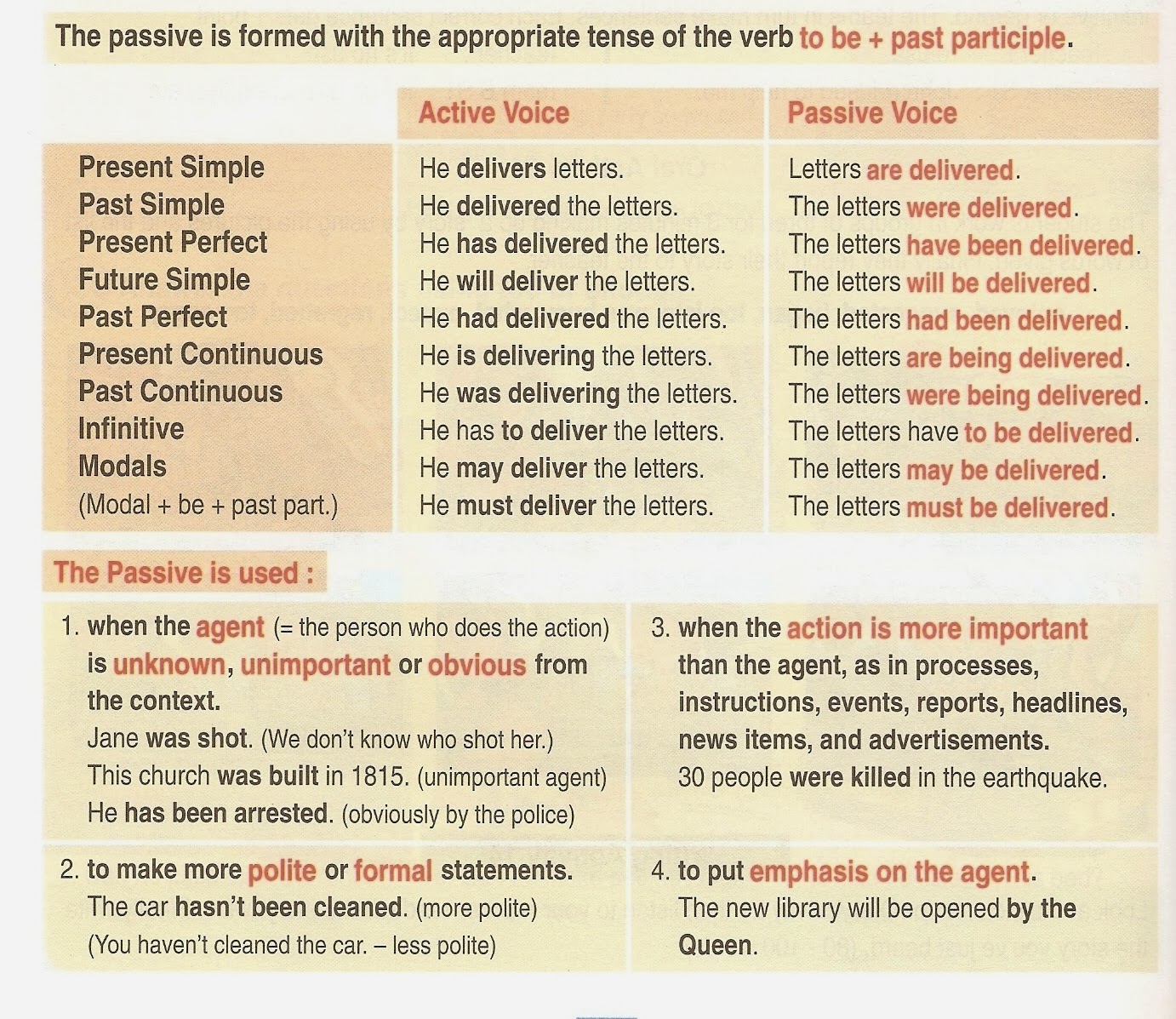
When do we use the passive voice?

We use the passive when we don’t know, we don´t want to reveal it, it is evident, or it isn’t important, who does the action. We also use it when we want to give prominence to the ACTION rather than the verb. The passive is much more frequently used in English than in Spanish.

1. BASIC FORMATION: What is the form of the passive voice?

To change an active sentence to a passive one we have to follow three easy steps:

STEP 1:The object of the active becomes the SUBJECT of the passive.
e.g.  My father cleaned the car.
       The car was cleaned by my father.

STEP 2: The subject of the active becomes the AGENT of the passive preceded by the preposition "by"
 e.g. The manager fired the cleaner.
        The cleaner was fired by the manager.

STEP 3: To form the passive we need to emphasize the object and NOT the subject. To do this we need the VERB "TO BE" in the same tense that the verb in the active( i.e. if the ctuve verb is in the present perfect we put the verb "to be" in this same tense) and the past participle of the main verb.


form of "to be" + past participle = passive voice

e.g.  Carlos writes a letter. (present simole)
       The letter is written  ( to be in the present simple + past participle of "write")


The following tenses do not have a passive form: Present perfect continuous, Past perfect continuous, Future continuous and Future Perfect continuous, and, therefore, in the passive we will use their simple forms.


Now, why don´t you check these links?


Explanation
More explanations
Advanced tenses
Practice


2) Active sentences with two objects in passive.

When there are two objects in an active sentence, there are two possible active sentences and two possible passive sentences.
Possibility 1: The professor gave the students the books.
Possibility 2: The professor gave the books to the students.

There are two objects in each of the following sentences:
object 1 = indirect object: the students
object 2 = direct object: the books

An indirect object is very often a person, a direct object a thing. When a direct object is followed by an indirect one, we put "to" in front of the indirect object.

3. Impersonal Passive - It is said ...

Verbs without an object (intransitive verb) normally cannot form a personal passive sentence (as there is no object that can become the subject of the passive sentence). If you want to use an intransitive verb in passive voice, you need an impersonal construction – therefore this passive is called Impersonal Passive.
Plus, sometimes when you are reporting what people say or believe, you don ́t know, or you don ́t want to say, who exactly the `people ́ are. So you use an impersonal construction:
People believe that thousands of birds died.
The same idea can be expressed by using the passive in two different ways:
a) subject + passive of reporting verb + `to ́ infinitive
Hundreds of thousands of birds are believed to have died.
b) It + passive of reporting verb + that + clause
It is believed that hundreds of thousands of birds died.
Some other reporting verbs that can be used in this way are:
calculate, claim, consider, discover, estimate, expect, feel, hope, know, prove, report, say, show, think, understand, etc.
- With present t reference, the passive is followed by the present infinitive:
People think that Johnson is in Cardiff.
Johnson is thought to be in Cardiff.
- With past reference, the passive is followed by the pas t infinitive:
People believe that Johnson left Cardiff last month
Johnson is believed to have left Cardiff last month

- Present and past continuous infinitives are also used:
They think that the forger is living in Florence.
The forger is thought to be living in Florence.
People know that the suspect has been dealing with drugs.
The suspect is known to have been dealing with drugs.
- Passive infinitives can also appear:
 People believe that the portrait was painted by Vermeer.
The portrait is believed to have been painted by Vermeer.   

They think that the staff are given a bonus whenever they have to work overtime.
The staff are thought to be given a bonus whenever they have to work overtime.
- The reporting verb can also be past:
People considered the government had spent too much.
The government was considered to have paid too much.


4. Verbs with prepositions in passive

When we put an active sentence, where a preposition follows after the verb (e.g. break into, look after), into passive - the preposition remains immediately after the verb.

Someone broke into the pet shop.
The pet shop was broken into.

5. Causative Passive. Have/get something done

Used to refer to actions that are done FOR the subject rather than by the agent.
a.Have something done
I  don ́t know how to repair cars, so I ́m having mine repaired at the garage round the corner.
b. Get something done
I really must go to the hairdressers´ to get my hair cut

1

Opinion essay

Posted by Esther on 1:52


0

Modals and films

Posted by Esther on 7:45
Modales y películas

0

Resumen Modales

Posted by Esther on 7:31
HABILIDAD:

CAN expresa habilidades en el presente:

           I can swim
              Yo sé nadar

-COULD expresa habilidades en el pasado:

           I could jump when I was 8 years old
               Yo podía/sabía saltar cuando tenía 8 años

-BE ABLE TO expresa habilidades en otros tiempos verbales (ni presente ni pasado, ya que para eso utilizamos can y could), como por ejemplo en futuro:

            I won't be able to walk in a few weeks
           No podré andar en unas semanas

O en presente perfecto:

            I have been able to do my homework
           Yo he podido hacer mi tarea


A continuación veremos aquellos de PERMISO:
-CAN se utiliza para pedir permiso, normalmente a alguien conocido*

            Can you repeat, please?
              ¿Puedes repetir, por favor?

-COULD se utiliza para pedir permiso, de manera educada:

            Could you repeat, please?
           ¿Podrías repetir, por favor?

-MAY se utiliza para pedir permiso, de forma aún más educada:
      

            May I go out? 
           ¿Podría salir?

-MIGHT se utiliza igualmente para pedir permiso, pero de manera excesivamente educada (es muy poco común), aunque al traducirlo al español no se aprecia la diferencia:

            Might I go out?
              ¿Podría salir?

* Los verbos modales de permiso significan todos lo mismo, en lo que se diferencian es en queunos expresan más educación y otros menos. Los más comunes son could y may, pero might al ser excesivamente educado, no se utiliza apenas.


Los siguientes son los de OBLIGACIÓN:

En ellos hay mucha variedad. Cada tipo de verbos modales de obligación dependerá de si ésta esmoral (es decir, por voluntad propia) o impuesta. Dentro de este tipo también se encuentran aquellos de prohibición.

-MUST expresa un deber muy fuerte o que sale de uno mismo:

           I must stop smoking
            Debo dejar de fumar

-HAVE TO/HAD TO (según sea presente o pasado) expresa una obligación que se me ha impuesto:

           I have to clean my bedroom
              Tengo que limpiar mi habitación

                 He had to work last Saturday


                   Tuvo que trabajar el sábado pasado

-MUSTN'T expresa prohibición:

           You musn't eat in class
             No debes comer en clase

-DON'T HAVE TO/ DIDN'T HAVE TO (Según sea presente o pasado) expresa algo que no es obligatorio:

           You don't have to tell this to Sara
          Tú no tienes que decírselo a Sara

-NEEDN'T* expresa que algo no es necesario (al igual que don't have to):

           I needn't clean the carpet
                    No es necesario que limpie la alfombra

 * También hay otra forma de decir que algo no es necesario con needdon't need. La diferencia entre uno y otro es que cuando utilizas needn't el verbo de a continuación debe ir con infinitivo sinto, como en el ejemplo anterior, pero si utilizas don't need el verbo que le sigue debe llevar to, al igual que pasa con don't have to.

También podemos emplear won't need para expresar futuro:

           I won't need these books next year 
                No necesitaré estos libros el año que viene

O needn't have + participio para referirnos a una acción del pasado que no era necesaria, aunque sí ocurró:

          We needn't have travelled by plane
            No hacía falta que viajáramos en avión

Para indicar que un objeto no es necesario, utilizamos don't need, ya que needn't solo se puede utilizar seguido de un verbo:

          You don't need potatoes
         No necesitas patatas

-NEED expresa que algo hace falta o se necesita, coincidiendo también con el significado dehave to. Necesita el auxiliar do/did para formar preguntas en presente y pasado, y con willpodemos referirnos al futuro.

          I will need you help
          Necesitaré tu ayuda

Need va seguido de infinitivo con to para indicar la necesidad u obligación de hacer algo, y no va seguido de infinitivo sin to cuando se indica la necesidad de un objeto:

          Mary needs to buy some potatoes
          Mary necesita comprar patatas

         Mary needs some potatoes
           Mary necesita patatas


También tenemos los de CONSEJO o RECOMENDACIÓN:

-SHOULD/OUGHT TO expresa una obligación moral en forma de consejoopinión advertencia. La diferencia entre uno y otro es que ought to es más formal que should, pero éste último se utiliza más.

          You should be more responsible
          Deberías ser más responsable

           You ought to be more responsible


           Deberías ser más responsable

-SHOULD HAVE expresa el arrepentimiento por una acción pasada que ahora se considera errónea o poco apropiada, o para criticar las acciones pasadas de otras personas.
          We shouldn't have travelled by plane. We needed the money
            No deberíamos haber viajado en avión, nos hacía falta el dinero

        You should have helped them


         Deberías haberles ayudado

-HAD BETTER sirve para dar consejos a una persona en un caso concreto, no en general, y para decir lo que es preferible hacer en él. Su negativa es had better not + infinitivo:

          They had better not ring up after 11 p.m.
            No deberían llamar después de las 11 de la noche

               You had better ask the doctor about the pain


                Sería mejor que le preguntaras al médico por tu dolor


Por último, veremos los de POSIBILIDAD:

-MUST expresa estar totalmente seguro sobre que algo es posible:

          She must be Jane's sister, she looks like her
           Ella debe ser la hermana de Jane, se parece a ella

-CAN'T expresa estar totalmente seguro de que algo NO es posible:
          It can't be your brother, ¡he is in Madrid!
             No puede ser tu hermano, ¡él está en Madrid!

-COULD expresa posibilidad en el presente y en el futuro:
         

          I could go to your house
         Podría ir a tu casa

-MAY expresa lo mismo*:

          I may go to you house
            Puede que vaya a tu casa

-MIGHT expresa lo mismo*

* La diferencia entre couldmay y might no se nota apenas. De could may hay un pequeño matiz en cuanto a más posibilidad, y de may might pasa exactamente lo mismo, por lo que los más comunes son could may.


0

Modals

Posted by Esther on 3:13


Modals from Esther M


Modals outline from Esther M


Copyright © 2009 ENGLISH VENTURED 1st BACHILLERATO All rights reserved. Theme by Laptop Geek. | Bloggerized by FalconHive.